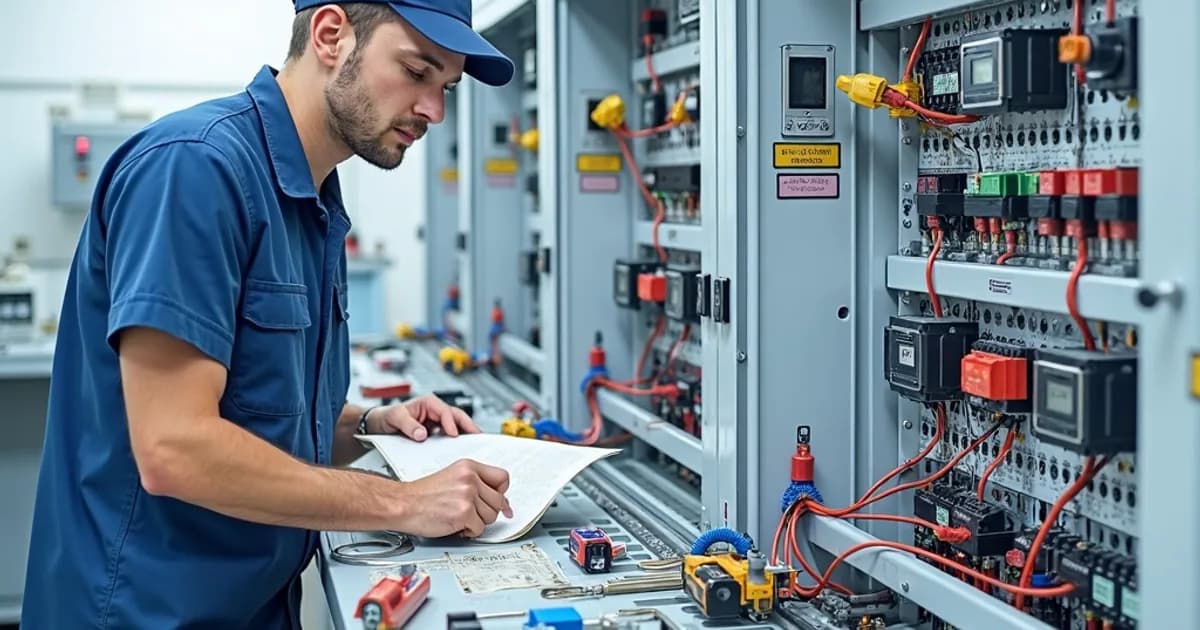
Thermal Management & Cooling Design
Thermal management and cooling design are crucial components of industrial control panel production, directly affecting the operational integrity, efficiency, and longevity of electronic components housed within. Efficient thermal management ensures that the internal temperatures remain within the specified operating range, commonly between 40-55°C, as outlined by standards such as UL 508A and IEC 61439. These temperatures must be maintained to mitigate risks such as derating of electronics, increased conductor resistance, accelerated insulation aging, and potential component failure. Proper thermal management involves not just managing excess heat generated by internal components but also considering external environmental conditions. The first step in effective thermal management is conducting a comprehensive heat load calculation. This involves assessing each component's power dissipation, which can be determined from manufacturer datasheets and specifications. The total heat generated provides a basis for the selection of cooling methods. Options vary from natural convection, which is suitable for low-density and lower power-dissipating enclosures, to forced ventilation for enhanced airflow. In environments where natural convection is insufficient, forced ventilation with fans or blowers can be employed. For even more demanding applications, especially in extreme ambient temperatures or high-density setups, advanced techniques such as air-to-air heat exchangers or closed-loop air conditioning systems are recommended. These systems ensure reliable operation by maintaining the internal environment regardless of external fluctuations and are vital in compliance with NFPA 79 Guidance for Industrial Machinery. When selecting a cooling strategy, panel builders and system integrators should consider both the internal and external environment. For outdoor panels, factors such as solar loading, proximity to other heat sources, or exposure to seasonal temperature variations must be factored into the design. UL 508A outlines best practices and requirements for these assessments. Integration of thermostats and temperature sensors can offer proactive management by identifying any deviations from expected temperatures and enabling timely interventions. The relevance of effective thermal management is amplified by the increasing compactness and power density of modern control panels. As components become more integrated and space within enclosures more constrained, the challenge of maintaining an optimal thermal environment intensifies. The use of simulation tools during the design phase can provide valuable insights by modeling heat distribution and identifying hot spots. These tools, aligned with IEC 61131-3 guidelines for automation systems, assist engineers in optimizing component layout to enhance natural airflow and minimize cooling requirements. Practical insights for panel builders include ensuring adequate spacing between components to facilitate airflow and selecting materials with favorable thermal properties. Applying gaskets and seals to manage ingress protection (IP rating) is also critical, as recommended by IEC 60529 standards. Control systems should incorporate feedback loops to dynamically adjust cooling mechanisms based on real-time thermal data. By closely adhering to these methodologies and standards, system integrators can significantly enhance the robustness, efficiency, and safety of industrial control panels, ultimately leading to reduced maintenance costs and prolonged system uptime.
Tools Required
- Thermal imaging camera (FLIR or equivalent)
- Digital thermometer with thermocouple probes
- Thermal calculation software or spreadsheet
- Anemometer for airflow measurement
- Component datasheets with power dissipation values
- Enclosure manufacturer thermal sizing tools
Applicable Standards
- IEC 61439-1 - Low-voltage switchgear assemblies (temperature rise requirements)
- UL 508A - Industrial Control Panels (thermal considerations)
- NEMA 250 - Enclosures for Electrical Equipment
- IEC 60529 - Degrees of protection provided by enclosures (IP Code)
Procedure Steps
Calculate Total Internal Heat Load
Determine the total power dissipation within the enclosure by summing the heat generated by every component. Obtain power loss values from manufacturer datasheets, which are expressed in watts and represent the difference between input power and useful output power. For components without published loss data, use conservative estimates: circuit breakers dissipate 2-6W each, terminal blocks 0.5-1W per pole under full load, contactors 3-10W each, and internal wiring generates resistive losses based on I2R calculations.
Determine Maximum Ambient and Internal Temperature Limits
Establish the maximum ambient temperature at the installation site and the maximum allowable internal enclosure temperature based on the lowest-rated component. Most industrial PLCs, VFDs, and power supplies are rated for operation up to 40-50 degrees C ambient, but derate at higher temperatures. The cooling system must maintain the hottest point inside the enclosure below the minimum rated temperature of all installed components under worst-case ambient conditions.
Evaluate Natural Convection Cooling Capacity
Calculate whether the enclosure's natural convective and radiative heat dissipation capability is sufficient to handle the total internal heat load. The natural cooling capacity depends on the enclosure surface area, material, color, and the temperature differential between the internal and external environments. Steel enclosures in still air can dissipate approximately 5.5 W/(m2 x K) of temperature difference through combined convection and radiation.
Select and Size Active Cooling Equipment
When natural convection is insufficient, select the appropriate active cooling technology based on the heat load deficit, enclosure IP/NEMA rating, and environmental conditions. Options include filtered fan ventilation (for clean environments where the enclosure rating can be maintained), air-to-air heat exchangers (for maintaining NEMA 4/4X ratings in contaminated environments), and enclosure air conditioners (for high heat loads in extreme ambient temperatures). Size the cooling equipment to handle at least 120% of the calculated heat load to account for degradation and dirty filters.
Optimize Internal Airflow and Component Arrangement
Design the internal layout and airflow path to ensure that cooling air reaches all heat-generating components effectively. Position cooling air inlet at the bottom of the enclosure and exhaust at the top to work with natural convection. Avoid creating dead zones where stagnant air allows localized hotspots to develop. Ensure that wire ducts and cable bundles do not obstruct the airflow path between cooling equipment and heat-generating components.
Implement Temperature Monitoring and Alarms
Install temperature sensors inside the enclosure connected to the PLC or a standalone temperature monitor to provide continuous thermal monitoring. Position sensors at the hottest expected location (typically near the top of the enclosure above VFDs) and at the air intake point of any cooling equipment. Program alarm thresholds to alert operators when temperatures approach component rating limits, allowing corrective action before thermal shutdowns occur.
Establish Maintenance Schedule for Cooling Systems
Define and document a preventive maintenance schedule for all thermal management equipment. Filter cleaning or replacement intervals depend on the environment: monthly in dusty or fibrous environments, quarterly in typical industrial settings, and semi-annually in clean environments. Include coolant level checks for air conditioners, fan motor current measurements, and thermal imaging scans of all power connections and components as part of the maintenance plan.
Related Procedures
Control Panel Design & Layout Planning
Plan and design control panel layouts that meet electrical standards, optimize wire routing, and ensure adequate spacing for maintenance and thermal performance.
Testing & Commissioning Procedures
Systematically verify control panel functionality through electrical testing, functional validation, and safety system verification before energizing in the field.
Related Categories
Need a Custom Control Panel Solution?
Our engineering team designs and builds industrial control panels to your exact specifications. Get a free quote today.
Frequently Asked Questions
References & Citations
International Electrotechnical Commission (IEC)
Rittal GmbH & Co. KG
vistaprojects.com
elepcb.com
automationdistribution.com
thermaledge.com
blog.se.com
library.automationdirect.com
eetimes.com
eecoonline.com
sytechprecision.com