Power Supplies
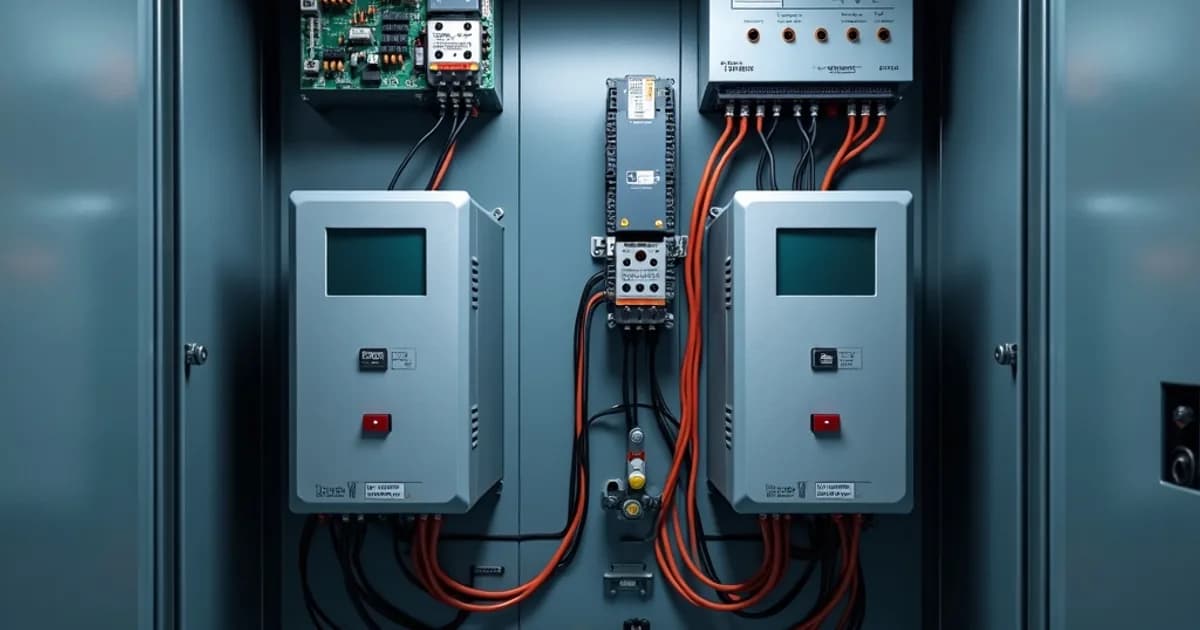
In industrial control panels, these essential components serve the critical function of converting AC mains voltage to the regulated DC voltages necessary for powering programmable logic controllers (PLCs), input/output (I/O) modules, sensors, and various electronic devices. The prevalent output specification is 24VDC, which has become the de facto standard for industrial control circuits due to its safety and compatibility advantages. This standardization aligns with IEC 61131-2 for control equipment, ensuring seamless integration across devices. Modern power supplies predominantly employ switched-mode technology, offering superior efficiency ranging from 90% to 96% and facilitating compact form factors and weight reductions. These power supplies are engineered to accommodate a broad input voltage range, typically from 85V to 264V AC, ensuring versatility across different geographic regions and varying power conditions. They often include diagnostic features such as DC OK signals, which provide feedback on operational status, and integrated output current monitoring to help prevent overload conditions. For applications where power reliability is critical, redundant configurations utilizing diode modules are frequently implemented. This redundancy ensures uninterrupted operation by automatically switching to a backup power source if the primary supply fails, crucial for minimizing downtime in essential industrial processes. When selecting a power supply for an industrial control panel, various criteria must be evaluated to ensure optimal performance and reliability. Key considerations include the required output voltage and current capacity, which must match or exceed system demands. Power efficiency directly impacts operating costs and thermal management, while the Mean Time Between Failures (MTBF) provides a statistical measure of reliability. Ambient temperature ratings predict how environmental conditions will affect performance, and relevant certifications—such as UL 508A for North American markets, CE for European conformity, and ATEX for hazardous environments—must be scrutinized to ensure compliance with safety and quality standards. These criteria are not only vital for establishing reliability but also crucial for meeting evolving industrial requirements. For example, the integration of Industry 4.0 principles necessitates power supplies that can interface with smart diagnostics and monitoring systems, enabling predictive maintenance and real-time energy management. Panel builders and system integrators must stay abreast of technological advances and industry standards to create solutions that drive both operational efficiency and system resilience. Incorporating these sophisticated power supplies into control panel designs allows for enhanced system performance and scalability. By leveraging state-of-the-art features and adhering to rigorous standards, such as those specified in IEC 61439 for low-voltage switchgear and control gear assemblies, engineers can ensure that their designs deliver reliable power solutions tailored to the demands of modern industrial automation landscapes. Understanding the nuances and technical specifications of power supplies is indispensable for professionals tasked with developing and maintaining robust industrial control systems.
Products in Power Supplies
Phoenix Contact QUINT POWER
Premium 24VDC DIN rail power supply with SFB Technology, preventive function monitoring, and NEC Class 2 output.
Siemens SITOP PSU100C 6EP1332-1SH71
Compact, single-phase power supply for automation applications.
Siemens SITOP Smart 6EP1353-2BA20
Reliable 24 V power supply for standard applications.
Siemens SITOP PSU8600 6EP3436-8SB00-0AY0
Advanced 24 V power supply system with digital communication interface.
ABB CP-E 24/10.1 Power Supply
The ABB CP-E 24/10.1 is a compact power supply unit delivering efficient power conversion.
ABB CP-S 24/20.0-5 Power Supply
Designed for high-performance, the ABB CP-S 24/20.0-5 provides robust power for industrial needs.
ABB CP-T 24/5.0 Power Supply
The ABB CP-T 24/5.0 provides reliable power conversion in a compact form factor.
Phoenix Contact QUINT4-PS/1AC/24DC/5
Advanced power supply with innovative technology ensuring high availability.
Phoenix Contact TRIO-PS/3AC/24DC/20
Reliable power supply designed for demanding industrial applications.
Phoenix Contact STEP-PS/1AC/24DC/2.5
Compact power supply ideal for building automation and control systems.
Weidmuller PROmax 30W 24V 1.3A
Reliable 30W power supply with a 24V output suitable for industrial applications.
Weidmuller ECO-RAIL-2 240W 24V 10A
Efficient 240W power supply with 24V output ideal for automation systems.
Weidmuller ConnectPower CPM 120W 5V 24A
Compact 120W power supply providing a stable 5V output for sensitive electronics.
Brands Offering Power Supplies
Applications Using Power Supplies
Related Categories
Need a Custom Control Panel Solution?
Our engineering team designs and builds industrial control panels to your exact specifications. Get a free quote today.
Frequently Asked Questions
References & Citations
International Electrotechnical Commission
docs.johnsoncontrols.com
astrodynetdi.com
literature.rockwellautomation.com
enerconpower.com
processsolutions.com
si.farnell.com
c3controls.com
ul.com
control.com
eaton.com