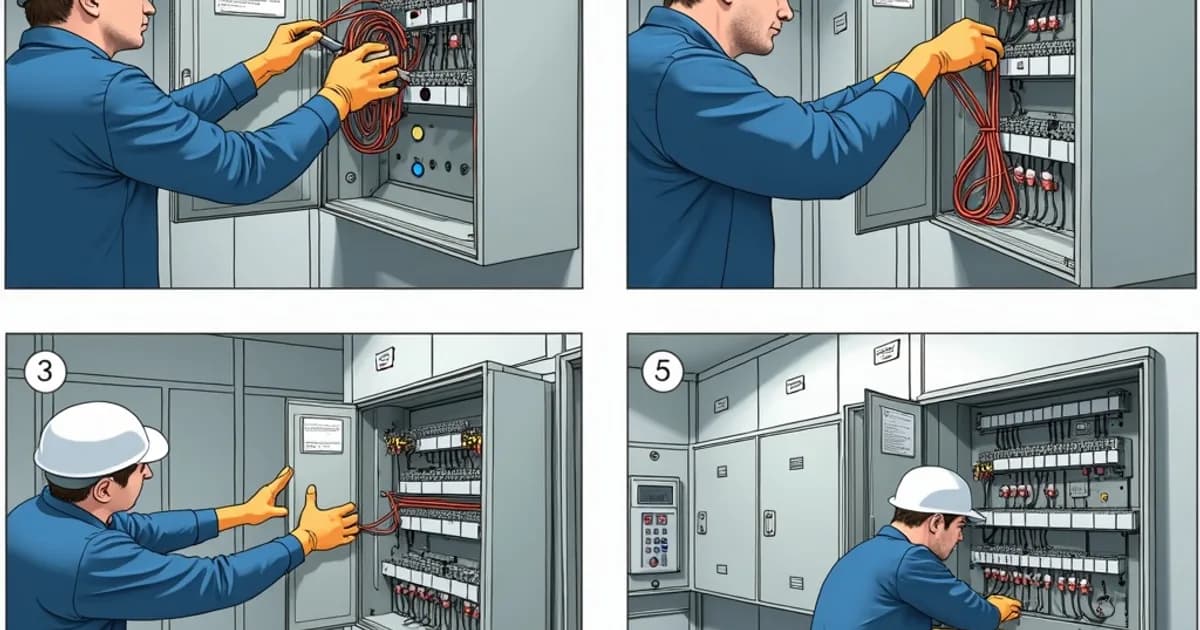
Grounding & EMC Shielding Techniques
Grounding and electromagnetic compatibility (EMC) shielding are crucial elements in the design and operation of industrial control panels. A well-engineered grounding system ensures electrical safety by providing a low-impedance path for fault currents. This allows protective devices such as circuit breakers to clear faults rapidly, thereby preventing hazardous touch voltages on exposed metallic surfaces. The need for a precise grounding system is dictated by standards such as UL 508A, which prescribes methods to ensure safety and performance. The standard outlines that all conductive parts likely to become energized must be grounded, with specific attention paid to short-circuit current paths and conductor sizing to maintain system integrity under fault conditions. Beyond ensuring safety, an effective grounding and shielding strategy is essential for maintaining signal integrity in environments rich with electromagnetic interference (EMI). Control panels often house sensitive electronics, including Programmable Logic Controllers (PLCs) and analog signal processors that can be adversely affected by EMI emanating from Variable Frequency Drives (VFDs), motors, and contactors. Standards like EN 61000-6-2 necessitate industrial installations to exhibit a high level of electromagnetic immunity. To achieve compliance, it is crucial to strategize the grounding layout and shielding arrangements. Implementing star-point or single-point grounding can significantly mitigate ground loops and common-mode noise that often lead to intermittent faults and communication errors. Shielding techniques are as significant as grounding in ensuring EMC. Correct termination of cable shields is fundamental; ideally, both ends of the cable shield should be connected to ground to provide a continuous path for shielding current and to dampen radiated emissions effectively. However, this must be done thoughtfully to prevent ground loops, particularly in vast installations where potential differences between grounded points can be substantial. Practical techniques, such as using insulated bushings or specialized connectors that provide 360-degree termination of cable shields, are recommended to ensure effective EMC containment. Selecting appropriate grounding and shielding methods requires considering the specific environmental factors and operational demands of each installation. EMC testing can identify potential weaknesses before full-scale deployment; techniques such as surge testing (in line with IEC 61000-4-5) can be utilized to assess the system’s resilience to power surges. It is also essential for panel builders and system integrators to stay updated with industry standards and apply lessons learned from previous implementations to address EMI and grounding challenges proactively. Proper implementation of EMC and grounding techniques ensures system uptime, enhances reliability, and reduces the risk of non-compliance with regulatory standards. Creating an effective grounding and shielding architecture at the outset prevents complex, time-consuming troubleshooting post-installation. Ultimately, adherence to protocols, combined with a commitment to best practices, leads to systems that not only meet compliance requirements but also exceed user expectations in performance and reliability. Engaging in continuous education on the evolving requirements of standards such as IEC 61439 for low-voltage switchgear and control assemblies propels industry professionals toward crafting robust and efficient solutions.
Tools Required
- Low-resistance ohmmeter (milli-ohm meter)
- Multimeter with AC millivolt range
- Oscilloscope with current probe
- Torque screwdriver (calibrated)
- Shield grounding clamps (EMC cable glands)
- Ground bus bar and accessories
- Cable shield stripping tool
- Anti-oxidant compound for aluminum connections
Applicable Standards
- UL 508A - Industrial Control Panels (Grounding requirements)
- IEC 61439-1 - Protective circuits and grounding
- IEC 61000-6-2 - EMC: Generic immunity standard for industrial environments
- NFPA 79 - Equipment grounding and bonding
Procedure Steps
Design the Panel Grounding Architecture
Plan the grounding system architecture before any physical installation begins. Establish a central ground bus bar as the single-point reference (star-point ground) for all ground connections in the panel. Design separate grounding paths for safety/protective earth (PE), signal/analog ground, and shield ground, all converging at the central ground bus. This star-point topology prevents ground loops that cause noise injection into sensitive circuits.
Install the Protective Earth (PE) Grounding System
Install the main protective earth ground bus bar and connect the incoming PE conductor from the facility's grounding electrode system. Bond the enclosure body, backplane, door, sub-panels, and all non-current-carrying metal surfaces to the PE bus using dedicated green/yellow ground conductors. Each ground conductor must be sized to carry the prospective fault current for the circuit it protects, with a minimum of 14 AWG (2.5mm2) for branch circuits per UL 508A.
Implement Functional Grounding for Sensitive Electronics
Establish a clean functional ground (FE or signal ground) for sensitive electronic devices such as PLC analog modules, communication interfaces, and precision measurement instruments. Connect each device's functional ground terminal directly to the central ground bus using a dedicated conductor, separate from the PE ground conductors. This prevents high-frequency noise from motor drives and switching transients from contaminating the signal reference plane.
Terminate Cable Shields for EMC Protection
Properly terminate the shields of all shielded cables entering the panel, including analog signal cables, communication cables (Ethernet, Profibus, RS-485), and VFD motor cables. The shield must be terminated as close to the cable entry point as possible using 360-degree EMC cable glands or shield clamp rails that provide a full circumferential contact between the shield braid and the grounded enclosure surface.
Install EMC Filters and Suppression Devices
Install EMC line filters on VFD input power connections and output dV/dt filters or sinusoidal filters on VFD motor outputs as required by the EMC assessment. Add RC snubber networks or varistor suppressors across contactor and relay coils to suppress switching transients that radiate electromagnetic interference. Install common-mode chokes on communication cables if the noise environment is severe.
Separate and Route Cables by EMC Category
Physically separate cables within the panel and at enclosure entry points into EMC categories: power cables (mains and motor feeds), control cables (discrete I/O, relay circuits), and sensitive signal cables (analog, communication, encoder). Maintain minimum separation distances between these categories: at least 200mm between power and signal cables running in parallel, and where cables must cross, ensure they cross at 90-degree angles to minimize coupling.
Verify and Document Grounding System Performance
After all grounding and shielding installations are complete, measure and document the resistance of every grounding path using a low-resistance ohmmeter. Verify that all ground connections measure less than 0.1 ohms from the component to the main ground bus. Check for ground loops by measuring AC voltage between the ground bus and each separately grounded point; any voltage above 50mV indicates a potential ground loop that should be investigated.
Related Procedures
Wiring Standards & Best Practices
Apply professional wiring techniques that ensure reliable connections, meet code requirements, and simplify troubleshooting in industrial control panels.
Control Panel Design & Layout Planning
Plan and design control panel layouts that meet electrical standards, optimize wire routing, and ensure adequate spacing for maintenance and thermal performance.
PLC Programming & Initial Setup
Configure PLC hardware, establish communication networks, develop structured control programs, and perform initial checkout for reliable industrial automation systems.
Related Categories
Need a Custom Control Panel Solution?
Our engineering team designs and builds industrial control panels to your exact specifications. Get a free quote today.
Frequently Asked Questions
References & Citations
International Electrotechnical Commission (IEC)
Institute of Electrical and Electronics Engineers (IEEE)
gerbincontrol.nl
blog.picamfg.com
smar.com.br
allpcb.com
revantechnology.com
customwireassembly.com
jj-lapp.com
panduit-prod-65.adobecqms.net
reo.co.uk
hypertherm.com